Modulo Orchestrator runs power and compute as one system
It forecasts how much power each site can spare, plans GPU work into it and dispatches the battery, chargers and GPUs every minute, inside the limit the utility sets.
Sites
- Commercial host125 kW · PG&EEvent
- Fleet depot125 kW · SCETaking requests
- Logistics park250 kW · Con EdisonNormal
- Food processor250 kW · seasonalNormal
- Office campus125 kW · SCEBatch paused
What you get
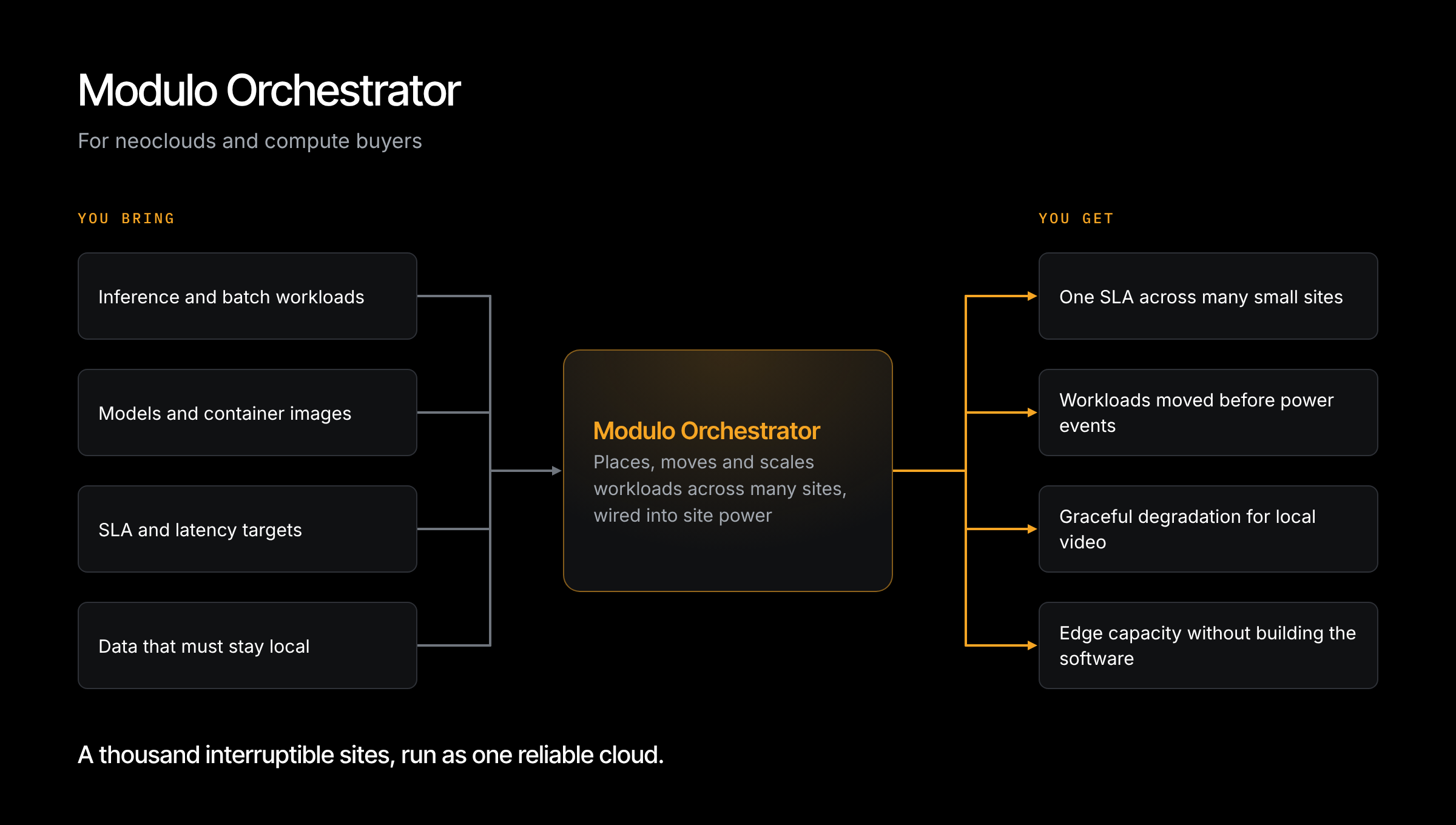
What you bring, what Modulo Orchestrator does with it, and what comes out.
Commercial host · event response
- Cut asked
- 70kW
- Delivered
- 71kW
- Compute lost
- 0kWh
Pool · 40 sites
Blue is the power each site can give to GPU work in this interval. Firm and interruptible capacity are sold from the pool.
Meet the Modulo Orchestrator
It treats a site's power and its GPU work as one plan. Firm work stays below an 80% line, flexible work fills the band above it, and the cheapest lever moves first when the grid gets tight.
Key features
- Forecasts in ranges
Load, solar, prices, grid events and utility limits, 72 hours ahead, as P10 to P90 ranges, so firm work is planned against the low end.
- Plans power and compute together
One plan covers the battery, EV charging, HVAC and every GPU job, checked in a simulator of the site before it goes out.
- Dispatches on site
Modulo Site AI acts every minute and keeps the site inside its limit even when the network link drops.
Built for the grid's rules
Slow loops set the limits. Fast loops work inside them.
- Horizon
- 72 hours, in 15-minute steps
- Output
- Ranges, P10 to P90
- Forecasts
- Host load, solar, prices, grid events, utility limits, battery state, EV traffic, compute demand
- Models
- Multimodal models and LLMs
- Accuracy target
- Within 5% of measured site import
- Day ahead
- Two-stage stochastic mixed-integer program
- Every 15 minutes
- Reinforcement learning, with model predictive control as fallback
- Every 5 minutes, on site
- Local re-plan against live load
- Objective
- Value minus cost, inside physical and compliance limits
- Checked by
- A simulator of each site before any plan goes out
- Cadence
- Every minute, on Modulo Site AI
- Levers
- Request routing, batch pauses, EV charging, HVAC, battery, generator, GPU power caps
- Order
- Cheapest lever first
- Firm compute
- Capped last, and only to hold the limit
- Import limit
- Held in seconds, whatever the plan says
- Utility emergency
- Back to the planning limit within 30 seconds
- Utility signal lost
- Stored planning limits after 15 minutes
- Network link lost
- The site keeps serving and re-planning on its own
When a site runs short, the cheapest lever goes first
Moving work costs almost nothing. The battery costs about 7.5¢ per kWh in wear and losses. Capping GPUs costs the most, so it comes last.
Planning estimates, at an H100 rate of $2.85 per GPU-hour.
- Route requests to another sitePer request, to a site where the model is warm≈ $0
- Pause batch work inside its deadlineIt catches up when power frees up≈ $0
- Shift EV charging, pre-cool buildingsWithin departure and comfort limits≈ $0
- Discharge the batteryOr run local generation, whichever costs less7.5¢/kWh
- Cap GPU power on flexible workPaid for in lost computeup to 92¢/kWh
- Cap firm computeOnly to hold the limitLast resort
A three-hour cut with no compute lost
On a hot weekday the utility asks a commercial host for 25% less power from 4 to 7 PM. The site has to shed 70 kW.
From meter data to a running site
Every new site follows five steps, and the Modulo Orchestrator proves itself on the site's own data before it controls anything.
- 01
Simulate
Run against 12 months of the site's 15-minute data.
- 02
Observe
Two weeks watching only, training forecasts on live meters.
- 03
Operate
Daily control under the site's limits.
- 04
Test events
Peak cuts and a two-step emergency.
- 05
Report
Five measured numbers, published.
What the site provides
- 12 months of 15-minute meter data
- Its tariff and any utility limit agreement
- Space for the Modulo Site AI cabinet
- A network link, with cellular backup
What IdlePower delivers
- Modulo Site AI, GPU power agent and on-site planner
- Forecasts and plans, every day
- Dispatch and protection, every minute
- A monthly report on limits, service and cost
Built for everyone at the meter
Earn from capacity you already have, without risking your service
The controller holds your import limit in seconds. Your own loads come first, and the pod's work fits around them.
Why the Modulo Orchestrator
- Your limit is held whatever any plan says
- Your loads are planned first, at their high-end forecast
- Your bills stay protected from new demand peaks
Capacity you can count on, in the tier you choose
Firm work never sits in the band the utility can cut. Flexible work is priced for what it gives up, and overflow goes to cloud GPUs.
Why the Modulo Orchestrator
- Firm work runs through grid events
- Warm models are routed to the nearest site with room
- Usage is metered in GPU-hours, tokens and energy
Load that follows your limits, and proves it
Hourly limits, emergency signals and demand-response events arrive over IEEE 2030.5 and OpenADR. Every action is logged against the revenue meter.
Why the Modulo Orchestrator
- 30 seconds back to the planning limit on an emergency
- Stored limits after 15 minutes without your signal
- Meter logs for every event and settlement
Talks to the utility, the building and the GPUs
One grid connector speaks both utility protocols. It is designed around flexible service connections such as PG&E Flex Connect, where the utility sends hourly limits the day before.
It sees the power event coming
Ordinary orchestrators react after a failure. The Modulo Orchestrator hears about shed events from Modulo Site AI on each site ahead of time and drains a site before the power drops.
- Acts before the outage
Advance signals from flex-connect schedules, utility events and load forecasts move work early.
- Degrades what can't move
Inference reroutes and batch resumes. Local video drops to a smaller model or frame rate instead of stopping.
- Plans where load goes
Spare headroom across the fleet and pre-staged model weights mean a move takes seconds.
- Open source
- Kubernetes, KServe, Ray Serve, llm-d, NVIDIA Dynamo
- Our layer
- Power-aware scheduling across sites
- Workloads
- Inference, batch, video and image analytics
- Sites
- IdlePower sites on spare grid capacity